Our Blogs
The Complete SOC2 Compliance Guide (2026): SOC1 vs SOC2, Type 1 vs Type 2, Audit Process & Implementation
The Complete SOC2 Compliance Guide for SaaS, Fintech & Cloud Companies (2026)
At ITIO Innovex Pvt Ltd, we offer a robust SOC 2 solution. It helps businesses launch their own branded payment system.
It is quick and easy to use.
You don’t need months or years to build from scratch. With ITIO, you can go live in just a few weeks.
Our platform is built for:
- Fintech startups
- Digital banks
- E-commerce businesses
- Enterprises and founders
We provide everything you need.
This includes technology, security, and scalability.
As a result, you can focus on growing your business.
About Us at ITIO - Leading the Charge in SOC2
At the heart of ITIO lies a bold vision. It is a future where advanced technology integrates seamlessly into everyday life.
This vision focuses on enhancing user experiences. Additionally, it accelerates business growth and builds stronger global connections.
We proudly stand at the forefront of this digital transformation. Furthermore, we continuously push boundaries and redefine excellence.
We work across key domains such as:
- Mobile app development
- SOC2 technologies
- Comprehensive white-label payment gateway solutions
- Robust AWS Cloud integration services
Our dedicated team includes:
- Engineers
- Designers
- Compliance specialists
- Fintech strategists
SOC2 has quietly become one of the most powerful revenue enablers in the global SaaS and cloud ecosystem. In 2026, enterprise buyers rarely purchase software without first reviewing a vendor’s SOC2 report. Security questionnaires that once took weeks are now replaced by a single question:
“Can you share your SOC2 report?”
If the answer is yes, deals move forward. If the answer is no, deals slow down, stall, or die.
This guide is designed to be the most complete and practical SOC2 resource on the internet, especially for founders and teams in India building global SaaS, fintech, and cloud companies.
We will go far beyond definitions. You will learn:
• What SOC2 really is (in simple language)• Why it has become mandatory for global sales• The full audit process step-by-step• SOC2 Type 1 vs Type 2 explained clearly• Realistic costs in 2026• Tools, timelines, and checklists• Mistakes founders make and how to avoid them• India-specific guidance for implementation teams
By the end, you will know exactly how to start your SOC2 journey.
What is SOC2? (Explained Like You’re Busy)
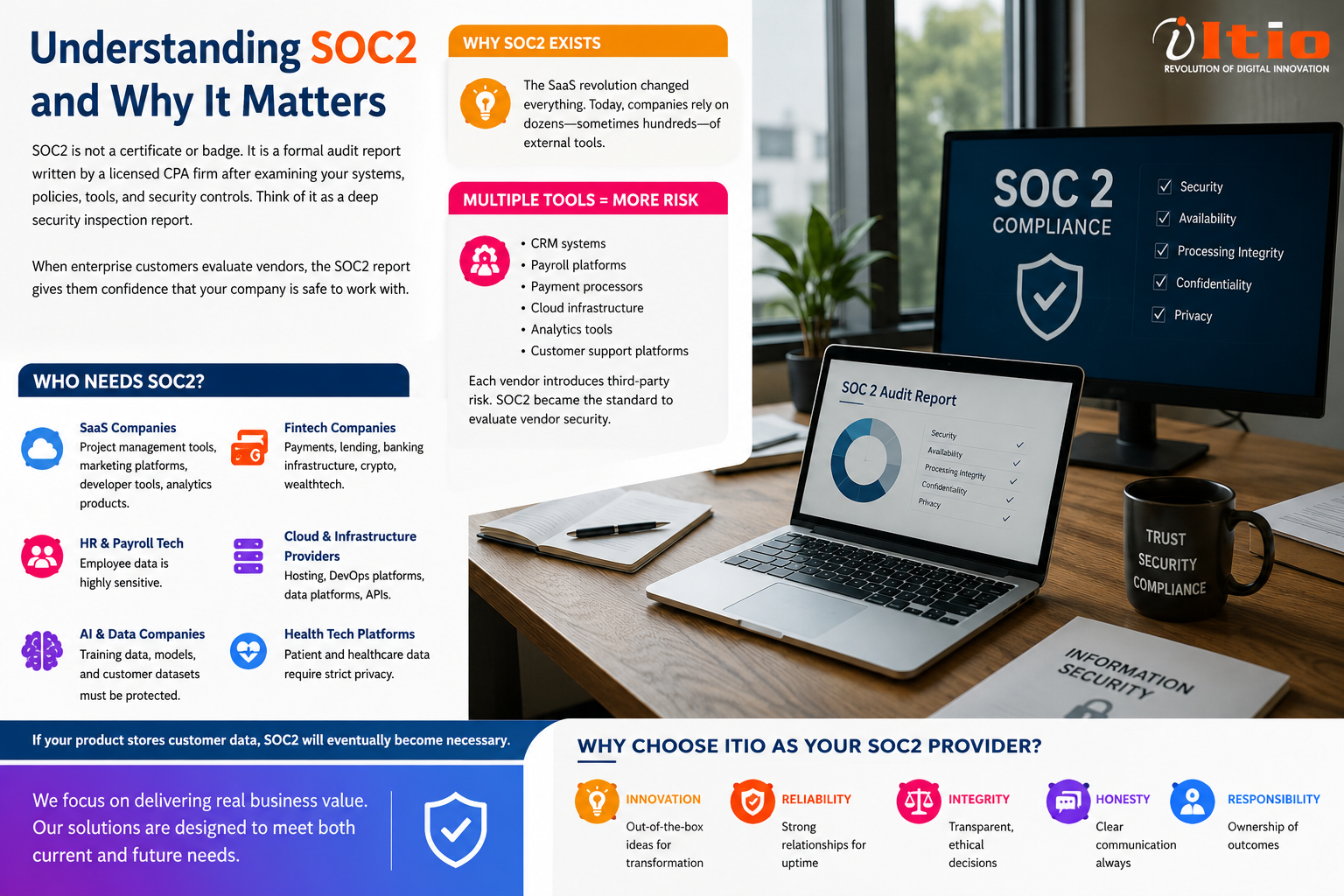
SOC2 stands for Service Organisation Control 2.
It is a security and compliance framework developed by the American Institute of Certified Public Accountants (AICPA). The purpose of SOC2 is to ensure that companies handling customer data do so securely and responsibly.
Here’s the simplest way to understand SOC2:
SOC2 is proof that your company:• protects customer data• follows documented security processes• monitors and improves controls continuously• can be trusted by large enterprises
Many founders think SOC2 is a certificate or badge. It is not.
SOC2 is actually a formal audit report written by a licensed CPA firm after thoroughly examining your company’s systems, policies, tools, and security controls.
Think of it as a deep security inspection report.
When enterprise customers evaluate vendors, the SOC2 report gives them confidence that your company is safe to work with.
Why SOC2 Exists
Before cloud computing, companies stored most data internally. Vendors rarely accessed sensitive customer information.
The SaaS revolution changed everything.
Today, companies rely on dozens sometimes hundreds of external tools:
• CRM systems• Payroll platforms• Payment processors• Cloud infrastructure• Analytics tools• Customer support platforms
Each vendor introduces third-party risk.
Enterprise buyers needed a standardized way to evaluate vendor security.SOC2 became that standard.
Who Needs SOC2?
SOC2 applies to any company that stores, processes, or transmits customer data.
Typical industries include:
SaaS companies
Project management tools, marketing platforms, developer tools, analytics products.
Fintech companies
Payments, lending, banking infrastructure, crypto, wealthtech.
Cloud & infrastructure providers
Hosting, DevOps platforms, data platforms, APIs.
HR & payroll tech
Employee data is highly sensitive.
Health tech platforms
Patient and healthcare data require strict privacy.
AI & data companies
Training data, models, and customer datasets must be protected.
If your product stores customer data, SOC2 will eventually become necessary.
Why Choose ITIO as Your SOC2 Provider?
Core values set us apart:
- Innovation - Out-of-the-box ideas for transformation
- Reliability - Strong relationships for uptime
- Integrity- Transparent, ethical decisions
- Honesty - Clear communication always
- Responsibility - Ownership of outcomes
Furthermore, we focus on delivering real business value. Our solutions are designed to meet both current and future needs.
We rank among the top SOC2 Certifications for businesses.
Why SOC2 Became Mandatory in 2026
Five major forces pushed SOC2 into the mainstream.
1) Explosion of Cyber Attacks
Cybercrime costs are projected to exceed $10 trillion annually. Ransomware, supply chain attacks, and AI-powered phishing have increased dramatically.
Enterprises now assume every vendor is a potential attack vector.
SOC2 proves your company takes security seriously.
2) Vendor Risk Management Programs
Large companies now run formal vendor risk assessments.
Procurement teams require vendors to submit:
• Security questionnaires• Penetration test reports• Compliance certifications
SOC2 dramatically reduces this burden.
Instead of answering 300+ security questions repeatedly, you share your SOC2 report once.
3) Faster Enterprise Sales
SOC2 shortens security reviews by 30%–50%.
Without SOC2:Sales cycles can stall for months during security reviews.
With SOC2:Deals move forward quickly because security teams already trust the report.
Many startups report their first enterprise deal closing right after achieving SOC2.
4) Investor Expectations
VCs and private equity firms increasingly evaluate security maturity during due diligence.
SOC2 signals:• operational maturity• risk management discipline• enterprise readiness
SOC2 can positively influence funding rounds.
5) Global Privacy Regulations
New data protection laws worldwide include:
- GDPR (Europe)
- CCPA (California)
- India’s DPDP Act
- Brazil's LGPD
- Australia's Privacy Act
SOC2 aligns closely with these laws, making compliance easier.
The Real Business Benefits of SOC2
SOC2 is not just a compliance checkbox. It creates real, measurable business impact.
Shorter Sales Cycles
Companies with SOC2 reports often see:• fewer security questionnaires• fewer procurement delays• faster deal approvals.
This can reduce sales cycles by months.
Higher Win Rates
When competing against vendors without SOC2, your company immediately appears more trustworthy.
Enterprise buyers prefer low-risk vendors.
SOC2 becomes a competitive advantage.
Larger Contracts
Enterprises are more comfortable signing:• multi-year agreements• larger deal sizes• long-term partnerships
SOC2 helps unlock bigger opportunities.
Stronger Customer Retention
Customers feel safer keeping long-term contracts with vendors that demonstrate strong security.
Trust increases retention.
Better Internal Security Culture
SOC2 forces companies to:
- document processes
- implement monitoring
- train employees
- establish incident response plans
This reduces real security risks.
SOC2 Is Not Only for Big Companies
A common myth is that SOC2 is only for large enterprises.
In reality, many companies start SOC2 with:
- 5–20 employees
- Seed or Series A funding
- Early enterprise customers
Starting early is actually easier and cheaper.
Understanding the Five Trust Services Criteria (TSC)
SOC2 audits evaluate your controls against the Trust Services Criteria.
At ITIO, we implement multiple layers of enterprise-grade protection to ensure maximum safety.
This includes:
- End-to-end encryption using the latest TLS protocols
- Advanced cardholder data tokenization to remove sensitive data storage risks
- Full SOC2 compliance certification
There are five categories:
- Security (mandatory)
- Availability
- Processing Integrity
- Confidentiality
- Privacy
Let’s explain each in simple terms.
1) Security (Mandatory for Every SOC2 Audit)
Security is the foundation of SOC2.
This category focuses on protecting systems from unauthorized access.
Key controls include:
- Multi-factor authentication
- Access control policies
- Encryption
- Security awareness training
- Incident response plans
- Vulnerability management
- Logging and monitoring
Every SOC2 audit includes Security.
2) Availability
Availability ensures systems remain operational and accessible.
Important for:
- SaaS platforms
- APIs
- Infrastructure providers
Key controls:
- Backup systems
- Disaster recovery plans
- Uptime monitoring
- Capacity planning
Customers expect reliable services.
3) Processing Integrity
Processing integrity ensures systems process data accurately and completely.
Critical for fintech and billing platforms.
Examples:
- Transaction validation
- Error handling
- Reconciliation processes
- Monitoring data pipelines
4) Confidentiality
Confidentiality protects sensitive business information.
Examples:
- Contracts
- Intellectual property
- Internal documents
Controls include:
- Data classification
- Encryption
- Access restrictions
5) Privacy
Privacy focuses on personal data protection.
Relevant laws include:
- GDPR
- CCPA
- India’s DPDP Act
Controls include:
- Data retention policies
- Consent management
- Data deletion procedures
How to Choose Which Criteria to Include
You don’t need all five.
Most companies start with:
- Security
- Availability
- Confidentiality
Fintech companies usually add:
• Processing Integrity
Healthcare and HR tech add:
• Privacy
Start with the minimum scope required by customers.
SOC1 vs SOC2 - Understanding the Difference
Many founders confuse SOC1 and SOC2.
Here is a simple explanation.
SOC1
Focuses on financial reporting controls.
Used by:
• Payroll providers
• Accounting platforms
• Financial service vendors
Primary audience:
• Auditors and finance teams.
SOC2
Focuses on security and data protection.
Used by:
• SaaS companies
• Cloud providers
• Fintech platforms
Primary audience:
• Security teams
• Procurement teams
• IT departments
If you sell software, SOC2 is the correct choice.
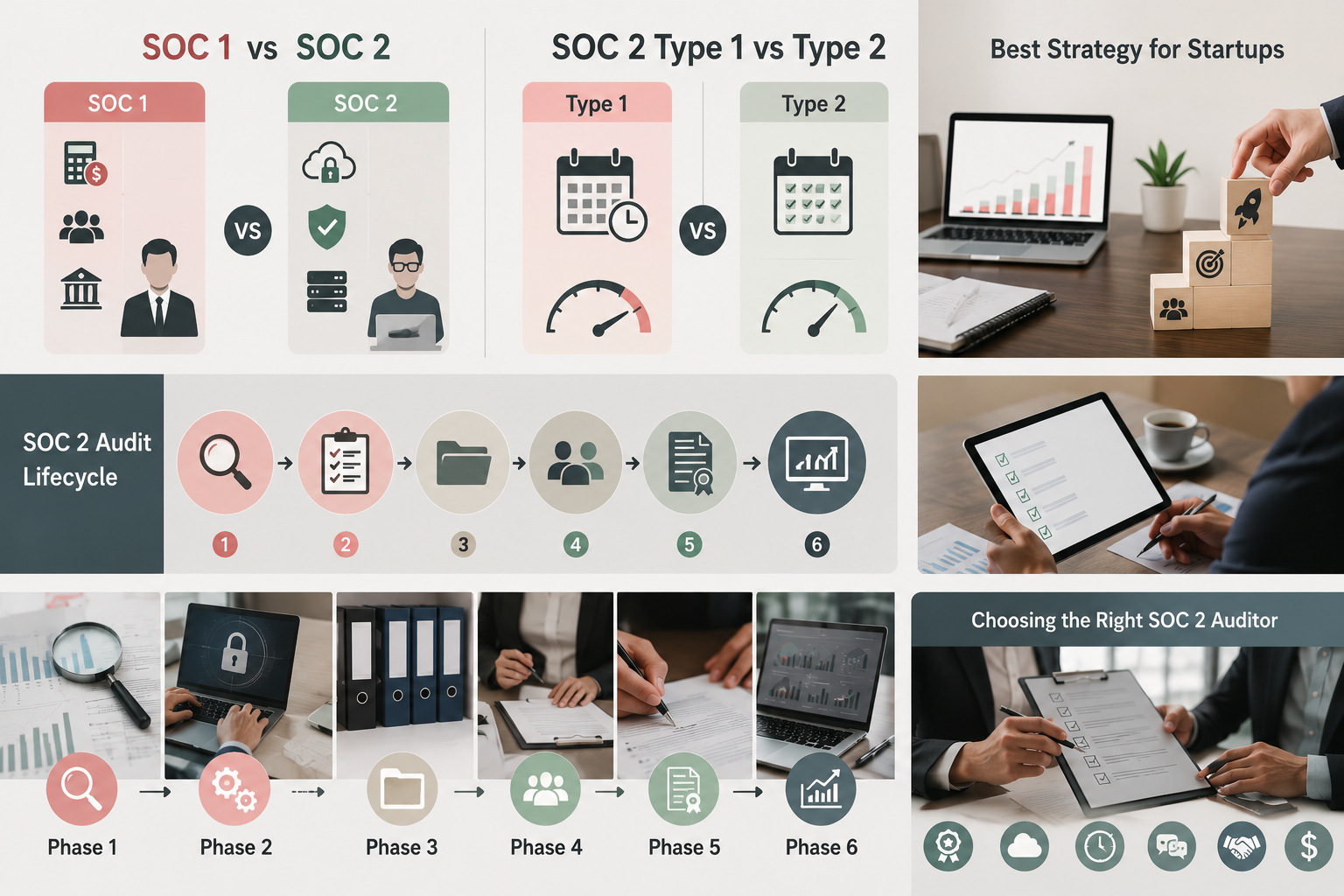
SOC2 Type 1 vs Type 2 - The Most Important Decision
This is one of the most common questions founders ask.
SOC2 Type 1
Evaluates whether your controls are designed properly at a single point in time.
Think of it as: A snapshot of your security setup.
Advantages:
• Faster
• Cheaper
• Good starting point
Timeline: 2-4 months (on-site).
SOC2 Type 2
Evaluates whether your controls work over time.
Auditors observe your company for 3-12 months.
This proves controls operate consistently.
Advantages:
- Required by most enterprises
- Much stronger trust signal
- Higher credibility
Timeline: 6-12+ months (Onsite).
8 Weeks (Offsite)
Best Strategy for Startups
Start with Type 1 → then upgrade to Type 2.
This approach:
- unlocks early deals
- builds momentum
- spreads costs over time
The SOC2 Audit Lifecycle Overview
SOC2 is not a one-time project. It is an ongoing compliance program.
The lifecycle includes:
- Readiness assessment
- Implementation
- Evidence collection
- Audit execution
- Reporting
- Continuous monitoring
We will explore each phase in detail next.
Phase 1- Gap Analysis / Readiness Assessment
This is where the SOC2 journey begins.
A readiness assessment answers one question:
How far are we from SOC2 today?
Activities include:
- Reviewing current policies
- Evaluating security tools
- Identifying missing controls
- Mapping risks
This phase creates your SOC2 roadmap.
Phase 2- Implementing Controls
This is the most time-consuming phase.
You will:
- Write policies
- Deploy tools
- Train employees
- Fix security gaps
Common implementations include:
- Password managers
- Device management
- Security training
- Vendor risk programs
- Backup systems
This phase transforms your security posture.
Phase 3- Evidence Collection
Auditors require proof that controls operate consistently.
Examples of evidence:
- Access logs
- Training records
- Security alerts
- Backup reports
- Incident response drills
Automation tools help collect this continuously.
Phase 4- Choosing the Right SOC2 Auditor
Selecting the right audit firm is one of the most important decisions in the entire SOC2 journey. A great auditor makes the process smoother, faster, and far less stressful. A poor auditor can slow your timeline and increase costs.
SOC2 audits must be performed by licensed CPA firms with experience in technology and cloud companies.
Questions to Ask Potential Auditors
Before choosing an auditor, ask these questions:
- How many SOC2 audits have you completed?
- Do you specialize in SaaS or fintech companies?
- What timeline should we expect?
- How will communication work?
- What support do you provide during remediation?
- What is included in the audit fee?
Comparing at least three firms is recommended.
Phase 5- The SOC2 Audit Execution
This is the formal audit period where the auditor evaluates your company.
The process usually includes:
Kickoff Meeting
The auditor explains:
- Scope
- Timeline
- Evidence requirements
- Communication plan
Document Review
Auditors review:
- Security policies
- Access control procedures
- Incident response plans
- Vendor management processes
Documentation quality matters greatly.
Control Testing
Auditors verify that controls operate effectively.
Examples:
- Reviewing access logs
- Checking onboarding/offboarding records
- Testing backup restoration
- Evaluating monitoring alerts
Employee Interviews
Auditors often interview:
- Engineering leaders
- Security teams
- HR teams
- IT administrators
They verify that policies are followed in practice.
Phase 6- Findings & Remediation
After testing, auditors may identify gaps called findings.
These are not failures; they are improvement opportunities.
Examples:
- Missing documentation
- Incomplete training records
- Weak vendor risk processes
You typically receive time to fix these before the final report.
Phase 7- The Final SOC2 Report
Once remediation is complete, the auditor issues your SOC2 report.
The report includes:
- Audit scope
- System description
- Controls evaluated
- Testing procedures
- Results and opinion
This document becomes your most powerful sales asset.
Continuous Compliance- The Ongoing Journey
SOC2 is annual. You must maintain controls year-round.
Continuous activities include:
- Monthly monitoring
- Quarterly access reviews
- Annual risk assessments
- Security awareness training
- Vendor reviews
Automation tools help manage this.
SOC2 Certification Cost in 2026- Full Breakdown
SOC2 costs vary significantly depending on company size and maturity.
Here is a realistic breakdown.
Small Startup (Type 1)
Total range: $20,000 – $50,000
Typical breakdown:
- Tools: $5k–$15k
- Consulting: $5k–$20k
- Auditor: $7k–$20k
Growing SaaS Company (Type 2)
Total range: $50,000 – $150,000+
Breakdown:
- Tools: $10k–$30k annually
- Consulting: $15k–$50k
- Auditor: $15k–$75k
Annual Maintenance
After first audit:
• $30k – $100k per year
Automation reduces long-term costs significantly.
How to Reduce SOC2 Costs
Smart planning can cut costs dramatically.
Use Compliance Automation Platforms
Popular tools include:
- Vanta
- Drata
- Scrut
- Sprinto
- Secureframe
These tools:
- Collect evidence automatically
- Monitor controls continuously
- Reduce manual work.
Automation can save tens of thousands annually.
Leverage Cloud Provider Compliance
Cloud providers already maintain SOC2 compliance.
Using their reports reduces your scope.
Examples:
- AWS
- Microsoft Azure
- Google Cloud
This dramatically reduces audit complexity.
Start With Minimum Scope
Begin with:
- Security criteria only
- Limited systems
- Smaller audit scope
Expand later.
SOC2 Implementation Timeline (Realistic)
A typical first-time SOC2 timeline:
Month 1–2: Ganalysis Month
Month3–5: Implement controls Month
Month6–9: Evidence collection Month
Month10–12: Audit and report
Total: 6–12 months.
Faster timelines are possible with automation.
SOC2 in India- Why It’s Booming
India has become a global hub for SOC2 readiness.
Cities leading adoption:
- Bangalore
- Hyderabad
- Pune
- Mumbai
Reasons:
Cost Advantage
Indian implementation costs are 30–50% lower.
Engineering Talent
Strong DevOps and security expertise.
Global Customer Base
Indian SaaS companies increasingly sell internationally.
SOC2 is now a key requirement for global expansion.
New SOC2 Trends (2026–2030)
Security evolves rapidly. SOC2 is evolving too.
AI-Powered Monitoring
Automated tools detect anomalies and risks in real time.
Zero Trust Architecture
Every access request must be verified.
Vendor Risk Focus
Supply chain attacks are increasing.
Continuous Compliance Dashboards
Real-time compliance tracking is becoming standard.
Extended SOC2 Preparation Checklist
Months 1–3
- Risk assessment
- Define policies
- Select tools
Months 4–6
- Implement controls
- Train employees
- Configure monitoring
Months 7–9
- Collect evidence
- Run internal audits
- Fix gaps
Month 10+
- Start audit
- Address findings
- Obtain report
Biggest SOC2 Mistakes to Avoid
Starting Too Late
Begin SOC2 before enterprise sales begin.
Poor Documentation
If it isn’t documented, it doesn’t exist.
Ignoring Vendor Risk
Third-party risk is heavily scrutinized.
Manual Evidence Collection
Automation saves huge effort.
Choosing Cheapest Auditor Only
Quality matters more than price.
Industry-Specific SOC2 Guidance
Fintech
Focus on:
- Transaction integrity
- Fraud detection
- Encryption
Healthcare
Focus on:
- Privacy
- Data retention
- Access controls
HR Tech
Focus on:
- Employee data
- Background checks
- Device security
Cloud Infrastructure
Focus on:
- Availability
- Monitoring
- Incident response Real SOC2 Success Stories from SaaS Companies
SOC2 is not just theory. Thousands of companies have used SOC2 to unlock growth, funding, and enterprise partnerships.
How SOC2 Impacts Enterprise Sales Conversations
SOC2 fundamentally changes the dynamic between vendors and enterprise buyers.
Before SOC2:• Long security questionnaires• Multiple meetings with security teams• Delayed procurement approvals• Lost deals due to perceived risk
After SOC2:• Faster security approval• Reduced due diligence friction• Increased trust early in sales• Higher close rates
Security becomes a sales enabler rather than a blocker.
The Role of Security Questionnaires After SOC2
SOC2 does not eliminate questionnaires, but it drastically reduces the workload.
Instead of answering hundreds of questions from scratch, you can:
- Share your SOC2 report
- Provide a summary of controls
- Reference audit results
Many customers accept the report as primary evidence.
How to Prepare Your Team for SOC2
SOC2 is a company-wide effort. Every department plays a role.
Engineering Team
- Secure development practices
- Code reviews
- Monitoring and logging
- Infrastructure security
HR Team
- Background checks
- Security training
- Onboarding and offboarding controls
IT Team
- Device management
- Access controls
- Patch management
Leadership Team
- Risk management
- Policy approval
- Resource allocation
SOC2 requires:
- Annual security training
- Phishing simulations
- Awareness programs
Employees become your first line of defense.
Vendor Risk Management- The Overlooked Requirement
Your vendors can become your weakest link.
SOC2 requires you to evaluate:
- Cloud providers
- Payment processors
- Email services
- Analytics tools
Typical steps:
- Vendor risk assessments
- Reviewing vendor compliance reports
- Maintaining vendor inventory
Incident Response: Being Ready for the Worst
Conclusion
ITIO provides a complete white-label payment gateway solution. It is fast, secure, and easy to use.
Whether you are a startup or an enterprise, we help you:
- Launch faster
- Scale globally
- Grow your revenue
Ready to launch your white-label payment gateway? Contact us today!
Starting early makes the journey smoother and more affordable.
Start Your Own Payment Gateway Business - ITIO Innovex
At ITIO, opt for a versatile solution and start your own payment gateway business, offering customizable, branded payment processing for your business.


